https://doi.org/10.1109/5.771073
Copied to clipboard!Shutterstock, a company headquartered in New York and Berlin, sells access to images as a “global provider, with hundreds of millions of images and videos available for browsing and downloading online.
They promote the fact that they have customers in over 150 countries and are accessible in 21 languages 1. I put in a search for “waving hand gesture footage” and found this piece of stock—an actor hired by “Stockbakery” performing what the title of the clip claims is “hello.” Among the millions of bits of imagery and footage to wash up in such a search, this one caught my eye because I initially misread it. I misread the gesture as far more ambivalent—even a gesture of refusal accompanying the word “no.” To me, the actor’s lips seemed to purse to form “no” and, as we all know, a waving hand can also be used to decline, to fend off, to stop or repel. The possibilities are actually rather infinite.
Looking again at the image of the “hello-waving-hand-gesture-by-young-man” one is reminded to consider that this is an image for sale. We don’t know the name of the man who is waving, but who is being waved at, and what meaning the wave will carry, is open to be determined by “you,” the potential buyer of this man’s visage. The bit of visual residue is on sale as a mobile kernel of future content. It pretends that it might not indicate anything tethered to a past, only that it is available precisely to be employed by “you.” This man’s performance is open to be in your hands. In fact, through stockbakery using the platform of shuttlestock, it is you who are being greeted. You – potential purchaser. Money will already have changed hands, we assume, in that the performer is legible as an actor (though these are the lines that are blurred by the profession of acting itself, which often strives, by the craft of acting, to appear “as if” not acting). But that call and that response, has become a new call seeking a new response within the frame of shutterstock. And I have decided to purchase that image for this digital book. So the beckoning gesture was, in that way, successful.
Capitalocene
Racial
Capitalocene
Lorem ipsum dolor sit amet, consectetur adipiscing elit. Sed luctus sed leo suscipit consequat. Pellentesque fringilla porta ante eu eleifend. Vivamus eu fringilla lectus, vitae porta odio. Praesent at ultricies libero. Phasellus tincidunt nibh et tincidunt luctus. Nunc fermentum hendrerit ipsum at tincidunt. Fusce tristique semper porta. Duis rhoncus lectus volutpat faucibus lobortis. Maecenas ac urna a eros commodo commodo.
Nam vitae egestas risus. Nunc dignissim et sapien vitae blandit. Proin euismod efficitur elit ut tempus. Pellentesque habitant morbi tristique senectus et netus et malesuada fames ac turpis egestas. Phasellus interdum risus mollis orci auctor, at eleifend est pulvinar. Suspendisse quis facilisis dui. Morbi mollis risus pellentesque, mollis enim nec, malesuada quam. Vivamus luctus mauris nisi, et condimentum sem commodo non. Quisque dictum tempus turpis, sed lacinia justo semper vitae. Mauris non lorem at mi feugiat faucibus vel vitae neque.
Sed at purus quam. Nam tortor diam, eleifend ac maximus vehicula, gravida ut urna. Fusce non lectus eu est facilisis consectetur at ac lacus. Fusce ornare urna id fringilla viverra. Aliquam eu rhoncus velit. Sed vel efficitur metus. Nulla a lacus sit amet metus pharetra egestas vel sed ante. Pellentesque volutpat ullamcorper ex, eu luctus lorem. Mauris dictum massa ac turpis vulputate, nec iaculis augue aliquam. Proin quam sem, volutpat ac mauris nec, lacinia tristique felis. Duis ac ipsum nec tortor pharetra lacinia. Pellentesque vitae condimentum lectus. Aliquam tempus, libero a efficitur rhoncus, tellus sem rutrum leo, id mattis sapien dolor eu mauris. Quisque sagittis velit aliquet nisl congue dignissim. Sed commodo volutpat suscipit. Morbi accumsan efficitur elit, id consectetur dolor condimentum vitae.
Lorem ipsum dolor sit amet, consectetur adipiscing elit. Sed luctus sed leo suscipit consequat. Pellentesque fringilla porta ante eu eleifend. Vivamus eu fringilla lectus, vitae porta odio. Praesent at ultricies libero. Phasellus tincidunt nibh et tincidunt luctus. Nunc fermentum hendrerit ipsum at tincidunt. Fusce tristique semper porta. Duis rhoncus lectus volutpat faucibus lobortis. Maecenas ac urna a eros commodo commodo.
Nam vitae egestas risus. Nunc dignissim et sapien vitae blandit. Proin euismod efficitur elit ut tempus. Pellentesque habitant morbi tristique senectus et netus et malesuada fames ac turpis egestas. Phasellus interdum risus mollis orci auctor, at eleifend est pulvinar. Suspendisse quis facilisis dui. Morbi mollis risus pellentesque, mollis enim nec, malesuada quam. Vivamus luctus mauris nisi, et condimentum sem commodo non. Quisque dictum tempus turpis, sed lacinia justo semper vitae. Mauris non lorem at mi feugiat faucibus vel vitae neque.
Sed at purus quam. Nam tortor diam, eleifend ac maximus vehicula, gravida ut urna. Fusce non lectus eu est facilisis consectetur at ac lacus. Fusce ornare urna id fringilla viverra. Aliquam eu rhoncus velit. Sed vel efficitur metus. Nulla a lacus sit amet metus pharetra egestas vel sed ante. Pellentesque volutpat ullamcorper ex, eu luctus lorem. Mauris dictum massa ac turpis vulputate, nec iaculis augue aliquam. Proin quam sem, volutpat ac mauris nec, lacinia tristique felis. Duis ac ipsum nec tortor pharetra lacinia. Pellentesque vitae condimentum lectus. Aliquam tempus, libero a efficitur rhoncus, tellus sem rutrum leo, id mattis sapien dolor eu mauris. Quisque sagittis velit aliquet nisl congue dignissim. Sed commodo volutpat suscipit. Morbi accumsan efficitur elit, id consectetur dolor condimentum vitae.
This refrain appears in the following chapters:
But gesture is complex. And the exchange of goods and services—that is, gesture in the service of capitalism – is of course the only beginning or end of the life of any gestural form. The hand wave, for instance, is arguably not owned by anyone, even if this bit of footage that carries it, promiscuous as it may be, is making money for shutterstock and stockbakery. And the greeting supposedly performed by the hello-waving actor is also more complex than it may at first seem.
Gesture
Gesture is promiscuous. It moves in multiple directions. As calls or as responses, a gesture ricochets off of precedent to inaugurate relation anew. Though the "hello" of a hand wave has been gestured countless times, each contingent call or response is a singularity, again. It may accompany sound, but can also stand on its own. It jumps body to body to body in transmission, like waves.
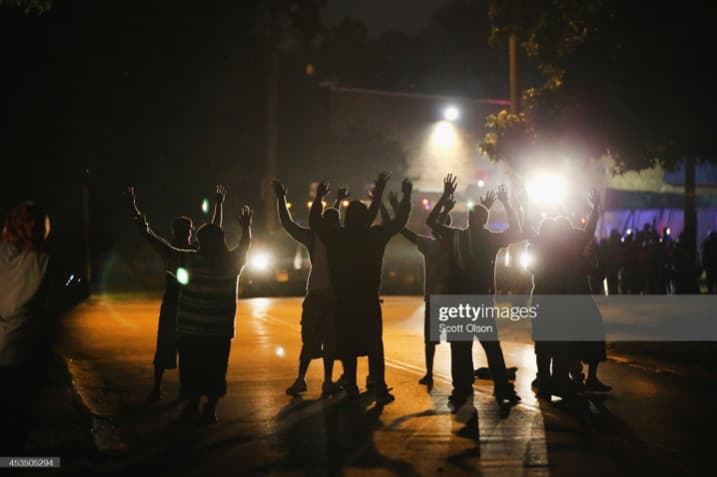
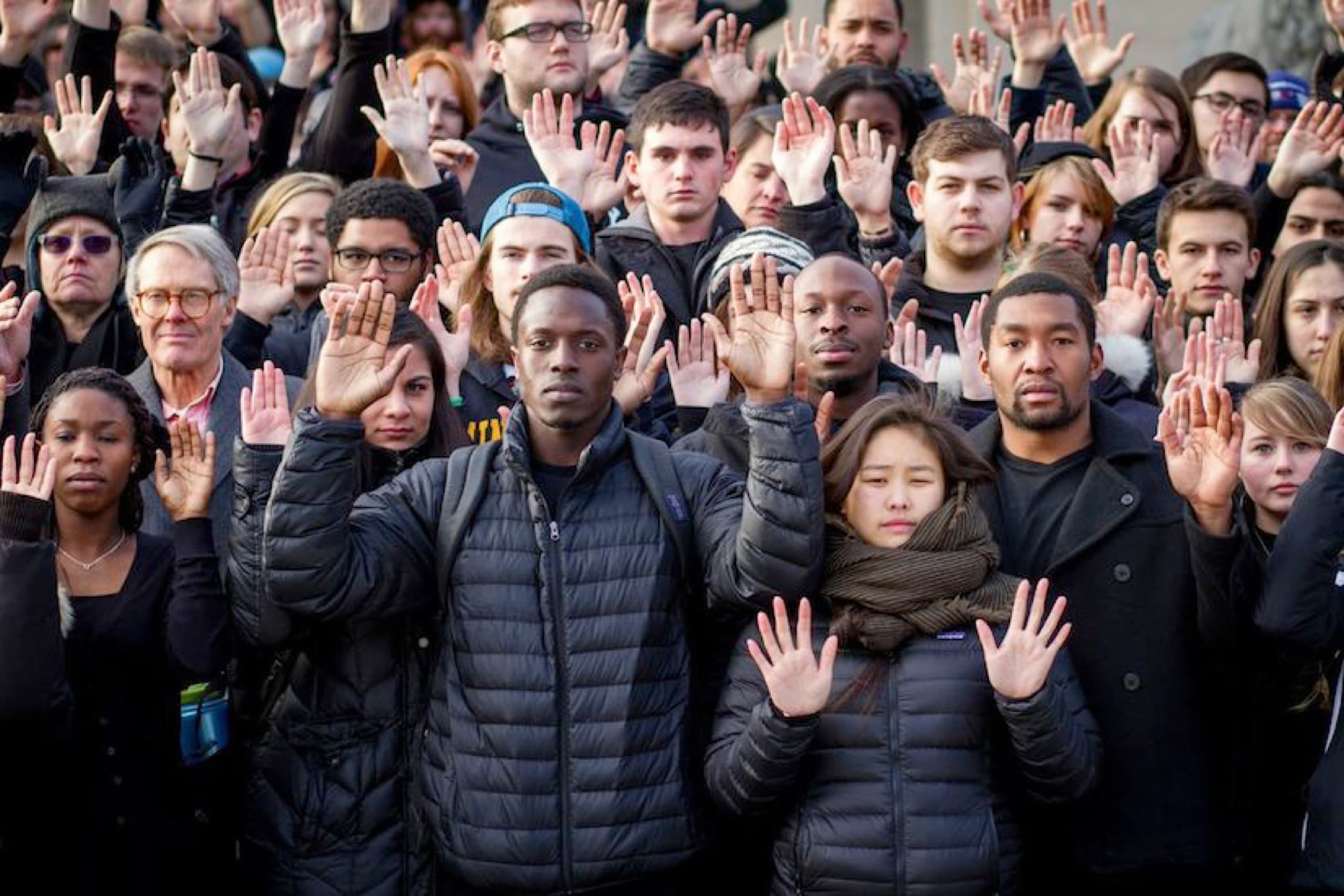
Embodied, a gesture of greeting might be a hand held up to welcome advance. But the same gesture might signal the inverse—Stop! A hand held up might say: I prefer not to. Or, Wait. The same gesture could pose a question or make a declaration. It might suggest that Here is the place, or that Now is the time. Or, Now is not the time! This is not the place! Arguably, attempts to pin gesture down to definitive meaning are attempts from which, as performances, they invariably escape, fugitive as well as (re)iterative. To use Sally Ann Ness and Carrie Noland's word, gestures “migrate,” nevertheless dragging history along with them (2008).
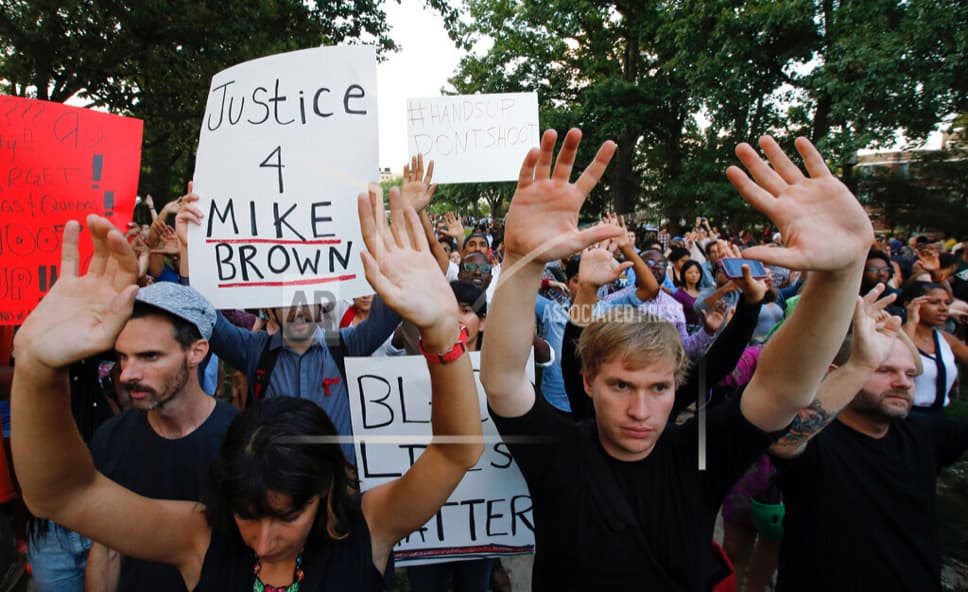
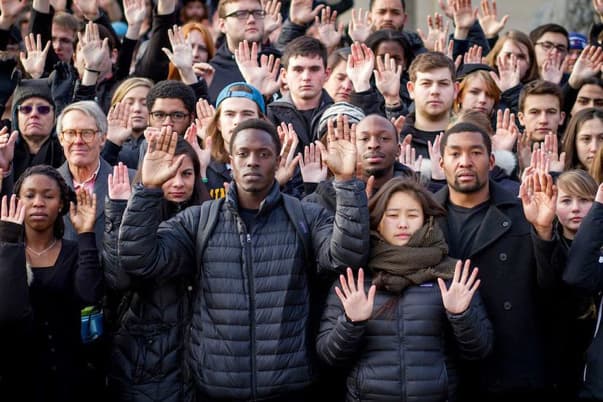
Gestures carry calls that extend off of a body or thing and often re-irrupt as response. A gestural greeting of “Hello” bouncing off one body toward another may be re-embodied on the rebound to carry the same gesture in an inverse direction as response: “Goodbye.” Regardless of meaning, however, hands raised or otherwise moved into the space between one and another (whether human or non ) are hands extended. They are hands entered into "intra-action," to use Karen Barad's word (2003:810). They are performances bodying forth the entangled histories and potentialities of relation--even without determined or definitive signification.
Think simply again of a wave of a hand, taken up and repeated. If I wave to you, you, perhaps, respond by waving back. Regardless of what the wave may mean as a gesture, an interval is generated, and potentially crossed, via iteration. The so-called past and the so-called future meet and greet at the site of reiteration: hello, hey you there, hold it, stand back, move along, yes, no, hello. A gesture, like a wave, is at once an act composed in and capable of reiteration but also an action extended, opening the possibility of future alteration. The cut of repetition suggests: it is in the future that our pasts await us--awaiting our response, awaiting our revisions, or even awaiting our refusal--waiting for the rebound or the redress. But also, and concentrically, it is in the past that our futures can be found, nodding their greetings to try again to try again. Greeting and greeting recombine, at the site of potentials for difference, and though every greeting drags a specific and situated history with it, it simultaneously offers a possibility that response may bring difference, provoking, inviting, even promising change in multiple directions.
Also, as the end of this chorus: “hands” don’t have to be human -- or hands at all! The Oxford English Dictionary defines gesture broadly as the "manner of carrying the body" and "movement of the body or any part of it." Whose body? As poets know, anything can gesture. A crab gestures in a Mark Doty poem; frost gestures according to Rupert Brooke; Ann Waldman states that every single letter in the alphabet is a gesture; and, though not a poet, Sara Ahmed writes that certain theories “merely” gesture toward their arguments (as if gesture were weak or unfulfilling) (2009). Bu If theory can gesture, along with crabs, frost, and letters, then gesture need not be attached to a human body. And the whole world opens to tne vave form and its endless, beckoning complexities!
The Essence of This Chapter Subheader
In this chapter, I will take up gestures as ongoing body-jumping performances that have the potential to carry history in different directions with each irruptive singularity. History is, after all, that which is carried along with us as well as that which has already happened. Recall that for Marcel Mauss in 1935, gestures are essentially iterative, which is to say, capable of reiteration, and thus always already in double, triple, or nth time. Gestures become themselves through their capacities to be, as he writes, "acquired" or, if you will, carried along in time and replayed. Indeed gestures and other techniques jump among bodies, often by ways of intermediary media, crossing intervals of time and place. In "Techniques of the Body" Mauss tells a story of women in France who had begun to walk like women in America by virtue of the cinema that had hosted the bodily techniques. Bodily techniques jumped, that is, body to body by riding the media that carried them host to host.
Perhaps all gestures open intervals. Perhaps all gestures are interval crossers as well as interval openers. Opening an interval, a greeting (a mode of gesture) establishes both proximity and distance, opening a space for response or crossing an interval with response, or both. Greeting, writes Avital Ronell, “establishes a relationality.” It is as if a gesture, moving air if nothing else, is not only the hand that articulates movement, but is composed of the spaces between and among us—the spaces through which it moves in or toward relation. Vectors of energy, or vectors of possibility, gestures suspend possibility on their way to ricochet or reiteration. Calling out or hailing becomes not only a matter of extension across, movement into, or suspension of an interval, but (re)inaugurates duration and the open possibility of response. Extended out beyond a body, a gesture is carried perhaps by air, perhaps by stone, perhaps by film, light, pixels, algorithms, or perhaps by body to body transmission. A photograph, for instance, might be said to suspend and simultaneously extend an action as a gesture, implicitly offering itself at the jump: to be picked up and played again by another (body or thing) in some reiterative combination of sameness and difference--that is, in some response. A vocal call, too, carries a gesture in the grain of the voice, such as the one from police: “Hey, you there!” In Louis Althusser's famous “little theoretical theatre” of interpellation the hail anticipates, if not demands, response. For Althusser, gesture establishes not only relation, but the whole gamut of ideology that rituals of hailing extend. Thus gesture bodies forth ideological precedent and casts it into the future by way of anticipated response, articulating a temporal and spatial interval that migrates body to body, even as that same interval is a potential site, dangerous as it may be, for alteration.
The Gesture and Shape of the Human Form Large Heading
The Essence of This Chapter Subheader
In this chapter, I will take up gestures as ongoing body-jumping performances that have the potential to carry history in different directions with each irruptive singularity. History is, after all, that which is carried along with us as well as that which has already happened. Recall that for Marcel Mauss in 1935, gestures are essentially iterative, which is to say, capable of reiteration, and thus always already in double, triple, or nth time. Gestures become themselves through their capacities to be, as he writes, "acquired" or, if you will, carried along in time and replayed. Indeed gestures and other techniques jump among bodies, often by ways of intermediary media, crossing intervals of time and place. In "Techniques of the Body" Mauss tells a story of women in France who had begun to walk like women in America by virtue of the cinema that had hosted the bodily techniques. Bodily techniques jumped, that is, body to body by riding the media that carried them host to host.
Perhaps all gestures open intervals. Perhaps all gestures are interval crossers as well as interval openers. Opening an interval, a greeting (a mode of gesture) establishes both proximity and distance, opening a space for response or crossing an interval with response, or both. Greeting, writes Avital Ronell, “establishes a relationality.” It is as if a gesture, moving air if nothing else, is not only the hand that articulates movement, but is composed of the spaces between and among us—the spaces through which it moves in or toward relation. Vectors of energy, or vectors of possibility, gestures suspend possibility on their way to ricochet or reiteration. Calling out or hailing becomes not only a matter of extension across, movement into, or suspension of an interval, but (re)inaugurates duration and the open possibility of response.
Extended out beyond a body, a gesture is carried perhaps by air, perhaps by stone, perhaps by film, light, pixels, algorithms, or perhaps by body to body transmission. A photograph, for instance, might be said to suspend and simultaneously extend an action as a gesture, implicitly offering itself at the jump: to be picked up and played again by another (body or thing) in some reiterative combination of sameness and difference--that is, in some response. A vocal call, too, carries a gesture in the grain of the voice, such as the one from police: “Hey, you there!” In Louis Althusser's famous “little theoretical theatre” of interpellation the hail anticipates, if not demands, response.
For Althusser, gesture establishes not only relation, but the whole gamut of ideology that rituals of hailing extend. Thus gesture bodies forth ideological precedent and casts it into the future by way of anticipated response, articulating a temporal and spatial interval that migrates body to body, even as that same interval is a potential site, dangerous as it may be, for alteration.
-
The content of the footnote appears in this data attribute. It might contain simple html tags here and there, but very simple.